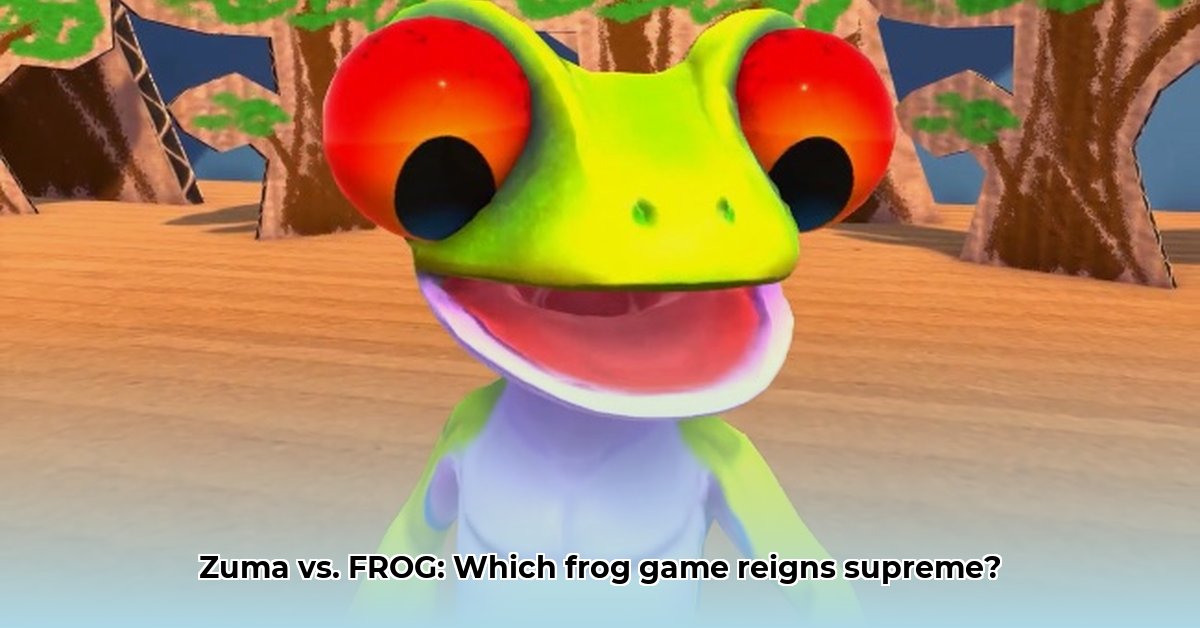
Ready to dive into the surprisingly diverse world of frog-themed puzzle games? This in-depth comparison pits two popular titles, Zuma and F.R.O.G., head-to-head to help you decide which amphibious adventure best suits your gaming style. While both feature frogs, their gameplay mechanics and overall experiences differ significantly.
Zuma: A Classic Match-3 Frenzy
Zuma's appeal lies in its instant accessibility. This classic match-three game (where matching three or more identical items removes them) places you in the flippers of a frog, launching colorful balls to create those crucial matches. The initial simplicity is deceptive; the pace intensifies rapidly, demanding quick reflexes and strategic thinking to prevent a relentless wave of balls from reaching the end. It's a visually stunning arcade experience, easily picked up but surprisingly challenging to master. Think of it as a digital game of "keep away," only with vibrant spheres and an increasingly stressed-out frog.
Pros:
- Immediate Engagement: The straightforward mechanics make it perfect for quick gaming sessions. Anyone can jump in and start playing.
- Visually Appealing: The bright, colorful design and smooth animations are genuinely captivating.
- Satisfying Gameplay Loop: The feeling of expertly lining up balls and triggering chain reactions is immensely rewarding, enhanced further by strategically-used power-ups.
Cons:
- Potential for Repetitiveness: The core gameplay loop, while initially engaging, can become somewhat repetitive over extended play sessions.
- Limited Depth: While enjoyable for short bursts, some players may find the lack of long-term complexity limiting. The core mechanics remain largely unchanged throughout the experience.
F.R.O.G.: A Physics-Based Puzzle Sandbox
F.R.O.G. offers a stark contrast to Zuma's straightforward approach. This 3D physics-based puzzle game replaces frantic ball-shooting with strategic environmental manipulation. You control a frog, using its tongue as a versatile tool to fling, pull, and push objects, solving intricate puzzles. Forget linear progression; think of it as a playful physics sandbox, encouraging creativity and experimentation. It's reminiscent of those classic Rube Goldberg machines—only you're the architect of chaos. The open-ended nature of the puzzles allows for multiple approaches, significantly enhancing replayability.
Pros:
- Unique and Engaging Gameplay: This fresh take on the puzzle genre sets it apart from the crowd. It's far more than simple matching; it's about manipulating your environment.
- Exceptional Replayability: The freedom to approach each puzzle in different ways promotes experimentation and offers high replay value.
- Emergent Gameplay: Unexpected interactions and solutions often arise, adding an element of surprise and delight.
Cons:
- Steeper Learning Curve: Mastering the physics engine and finding efficient solutions requires patience and practice. It's not immediately as intuitive as Zuma.
- Niche Appeal: The unique, physics-heavy approach may not appeal to all players, potentially alienating those seeking a more straightforward puzzle experience.
Zuma vs. FROG: A Head-to-Head Comparison
| Feature | Zuma | F.R.O.G. |
|---|---|---|
| Gameplay Style | Fast-paced, match-3, 2D | Physics-based, 3D, open-ended |
| Difficulty | Gradually increasing, linear | Variable, puzzle complexity varies greatly |
| Target Audience | Casual gamers, match-3 enthusiasts | Puzzle enthusiasts, creative problem-solvers |
| Replayability | Moderate | Very high |
| Overall Impression | Simple, instantly gratifying | More challenging, rewarding creativity |
Which Frog Game Reigns Supreme?
The "better" game depends entirely on your preferences. Do you crave instant gratification and a simple, yet thrilling, challenge? Zuma is your ideal choice. However, if you relish complex, brain-teasing puzzles and value creative problem-solving, then F.R.O.G. is the clear winner. Both games offer unique, engaging experiences—consider downloading both to experience the diverse world of frog-based puzzle gaming!
Creating Your Own Frog Physics Puzzle Game: Key Insights
Building a game like F.R.O.G. requires a unique blend of skill and design choices. The game's success hinges on several critical factors that aspiring game developers should understand.
Key Takeaways from F.R.O.G.'s Development:
- Innovative Tongue Physics: The innovative tongue mechanic is F.R.O.G.'s defining feature, requiring significant expertise in game physics development.
- Iterative Development: Extensive playtesting and iterative refinement were crucial for the game's success. User feedback is invaluable.
- Gameplay Evolution: The shift from a linear to an open-world design was a game-changer. Carefully consider your game's scope and potential for scaling.
- Engine Challenges: Scaling the physics engine presented optimization challenges. Plan for potential limitations from the outset.
- Efficient Asset Management: Although rapid prototyping was beneficial, efficient asset management is vital for long-term project health.
This comparative review provides a thorough analysis of two distinctly different frog games, offering valuable insights for players and game developers alike. Whether you choose the rapid-fire action of Zuma or the creative freedom of F.R.O.G., you’re in for an enjoyable and uniquely "ribbiting" experience.
⭐⭐⭐⭐☆ (4.8)
Download via Link 1
Download via Link 2
Last updated: Friday, May 16, 2025